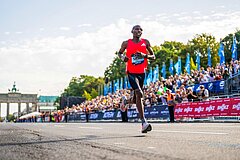



















Outstanding Performances at the BMW BERLIN-MARATHON 2026
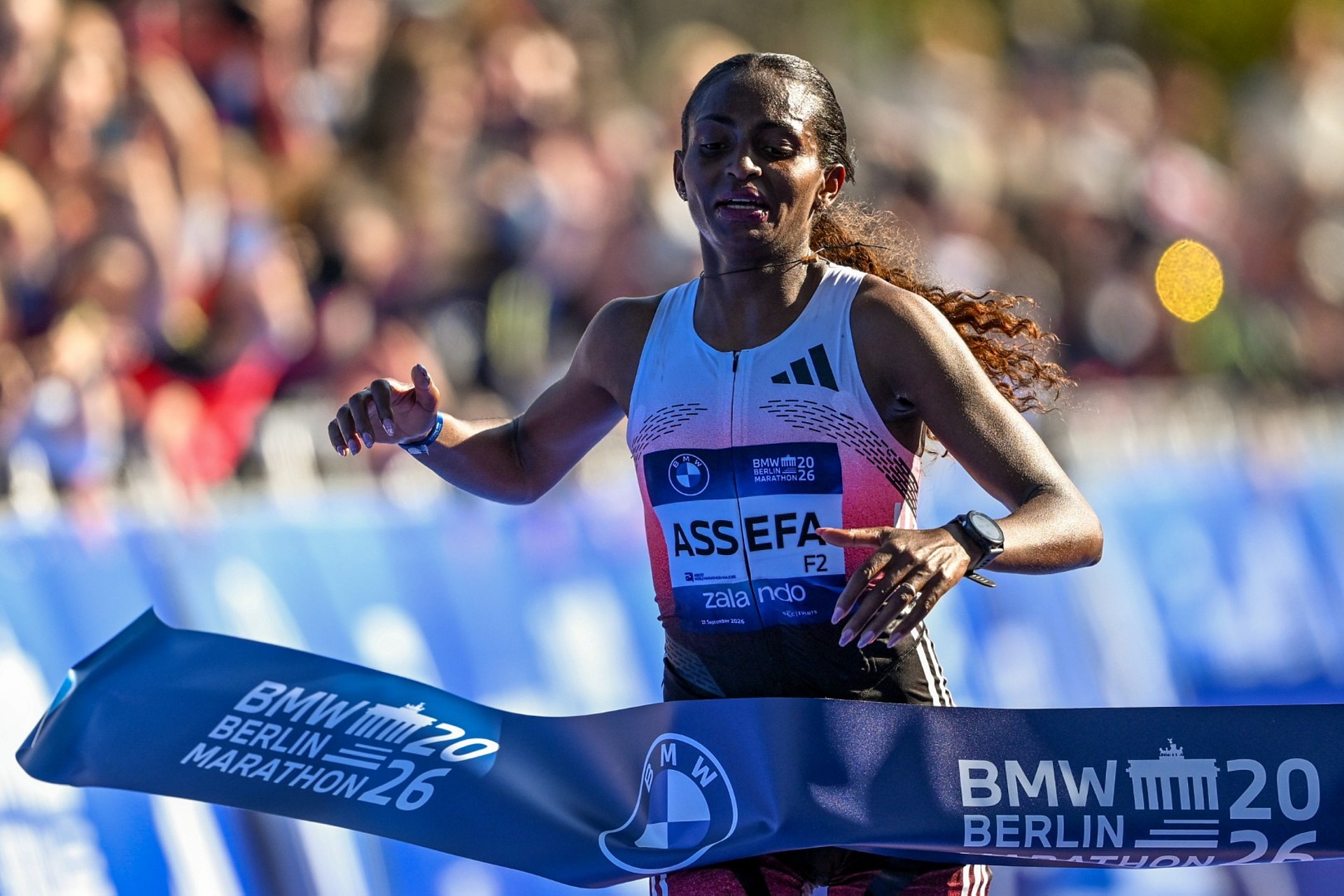
- Course record set in women’s race
- Thrilling men’s races
Tigst Assefa smashed the course record at the BMW BERLIN-MARATHON with 2:11:04. However the Ethiopian was extremely unlucky since she was well on course for the world record of 2:09:56 until around the 40 k mark. Due to a sudden injury in her right leg she was then limping and ultimately fell well short of the mark. Nevertheless Tigst Assefa’s time of 2:11:04 was still the third-fastest ever recorded. She won by a large margin ahead of her compatriots Bedatu Hirpa and Dera Dida, who took second and third place with 2:16:53 and 2:16:55 respectively. Surprisingly the fastest German woman was Berlin’s Anna Langerwisch (Marathon Team Berlin) in 16th place with 2:27:31. Esther Pfeiffer hoped to break the German record of 2:19:19 but withdrew from the race after around 14 km.
In good weather conditions there was an Ethiopian victory in the men’s race as well: Guye Adola clocked 2:02:50, winning at the Brandenburg Gate for the second time since 2021. Fellow-Ethiopian Gemechu Diriba was second in 2:03:19 ahead of Gabriel Geay of Tanzania, who crossed the line in 2:03:59. The fastest German runner was Haftom Welday in 16th with 2:08:25, missing his personal best by just twelve seconds. Adding the two winning times of the 52nd BMW BERLIN-MARATHON the race was the second fastest marathon in history. Only Chicago in 2024 (4:12:40) was faster than today’s marathon in Berlin with 4:13:54.
More than 56,000 runners from 162 nations entered the by far biggest and most spectacular marathon in German speaking territory. The BMW BERLIN-MARATHON is among the biggest raves over the classic distance worldwide.
The Women’s Race
Right from the start Tigst Assefa recorded split times that were consistently in the region of the world record. Running behind her pacers but unchallenged in the lead she passed the 10 k mark in 30:48, the half marathon in 64:57 and the 30 k point in 1:32:19. Then Tigst Assefa was even a couple of seconds further ahead in her chase to break the world record. With five kilometres to go the expected finishing time was 2:09:36. However at around the 40 k mark Tigst Assefa’s stride suddenly became uneven and shortly afterwards she began to limp noticeably. Her dream of a second world record in Berlin was shattered over the final 2,000 metres.
Having won the race in 2022 in 2:15:37, Tigst Assefa had stormed to the world record in 2023 with 2:11:53. On Sunday she won for the third time and set a course record for the third time as well – something that is unique in the history of the BMW BERLIN-MARATHON. However she was unable to celebrate her success and could not do any interviews after the race as she was taken to hospital to check her injury.
A second dream of a major record did also not materialize in Berlin: Esther Pfeiffer was aiming to break the 18 year-old German record set by Irina Mikitenko, who had won in Berlin in 2008 with 2:19:19. She started the race at a fast sub 2:20 pace. But at around the 14 k mark the 29 year-old had to pull out of her second marathon. “Unfortunately the enormous pressure of expectation took its toll today and affected her stomach, amongst other things. Esther set off at record pace, but due to her physical condition she was unable to continue. She will be back and still has big plans for the marathon,” said Hendrik Pfeiffer.
Due to the situation it was suddenly local Berlin runner Anna Langerwisch, who competes for the Marathon Team Berlin of the race organiser, who crossed the finish line as the top German runner. The 25 year-old finished 16th in 2:27:31, her first time under 2:30:00. This makes her the third-fastest German runner so far this year. “I am overwhelmed, because I never expected I could be the fastest German,” said Anna Langerwisch.
The Men’s Race
Led by pacemakers a group of eight runners passed the half marathon mark in 61:01. Three Ethiopians then broke away shortly before the 30 k mark: Guye Adola, Gemechu Diriba and Selemon Barega. However this leading group stayed together only briefly, as Guye Adola picked up the pace just under ten kilometres from the finish and broke away. The 35 year-old eventually crossed the line in 2:02:50, significantly beating his nine year-old personal best of 2:03:46, which he had ran on his debut in Berlin in 2017 when he finished second. “I am very happy – the race was good, but also tough. I was confident because I had trained well and my coach was optimistic too,” said Guye Adola who, like Tigst Assefa, is coached by Gemedu Dedefo in Addis Ababa.
Haftom Welday was the fastest German with 2:08:25. Unlike in previous races the 36 year-old held back a little this time and was more successful with this approach. Having dropped out in Berlin in both 2024 and 2025 he finished 16th this time. “My preparation did not go all that well, so I am happy and grateful to have achieved such a result today. Next spring, I want to improve on my personal best,” said Haftom Welday.